
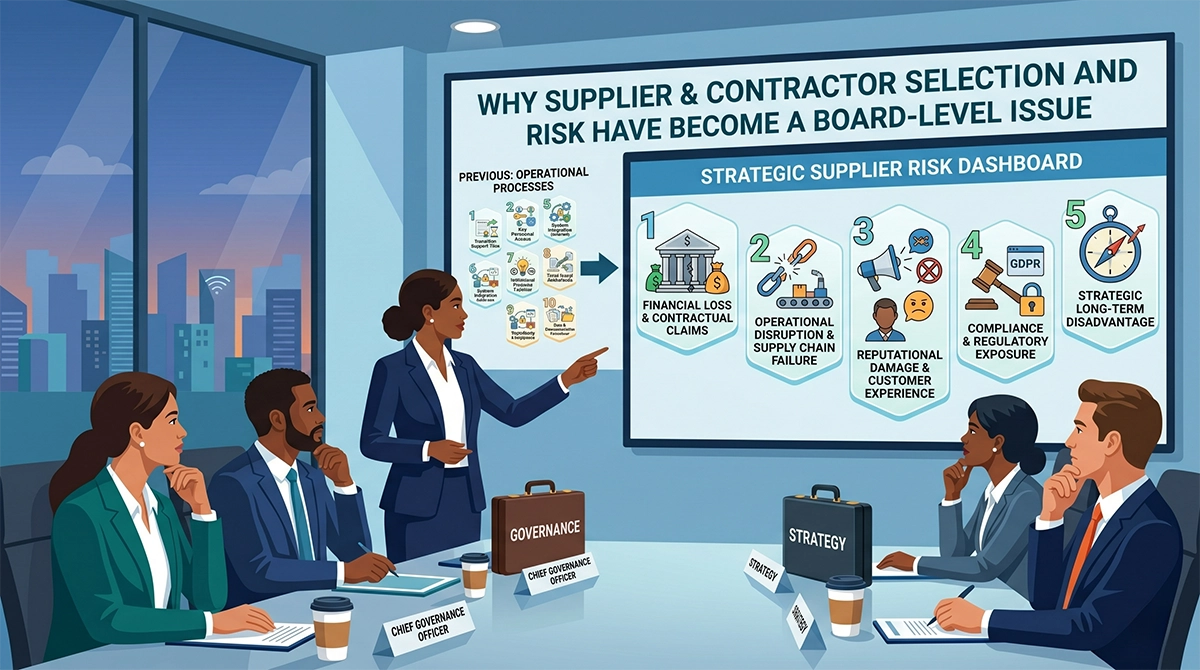
Over the last decade, organisations have experienced unprecedented levels of disruption from suppliers and contractors.
From supply chain instability and outsourcing failures to cyber threats, compliance breaches and operational underperformance, the consequences of poor supplier decisions are now far-reaching and highly visible. As a result, supplier and contractor risk is no longer viewed simply as a procurement issue. It has become a board-level concern. Today’s organisations increasingly recognise that selecting the wrong supplier can lead to operational disruption, reputational damage, customer dissatisfaction, contractual disputes, governance failures, financial loss, and long-term strategic risk.
This is fundamentally changing the way organisations approach procurement, commercial management and supplier governance. Moving Beyond Lowest Cost Procurement. Historically, many procurement exercises focused heavily on cost reduction. While commercial value remains important, organisations now understand that the cheapest supplier is not always the safest, most resilient or most capable supplier. Modern supplier selection requires a far more balanced commercial assessment. Organisations are increasingly evaluating:
- operational capability,
- governance maturity,
- financial stability,
- cultural alignment,
- resilience,
- service capability,
- compliance,
- and long-term partnership potential.
This represents a significant shift in commercial thinking. Supplier and contractor selection is no longer simply about purchasing goods or services. It is about protecting operational continuity and organisational performance. Modern organisations operate within increasingly complex commercial ecosystems. Many are heavily dependent upon:
- outsourced services,
- strategic suppliers,
- specialist contractors,
- technology providers,
- and third-party delivery partners.
- This dependency creates risk, and poor governance can result in:
- supplier failure,
- service interruptions,
- regulatory exposure,
- contractual disputes,
- poor customer experience,
- and weakened organisational resilience.
As a result, organisations are placing far greater emphasis on:
- supplier assurance,
- contractor evaluation,
- governance frameworks,
- and structured commercial oversight.
The Growing Importance of Structured Supplier Evaluation
One of the most common causes of supplier-related problems is poor evaluation during the selection process. Too often, organisations focus heavily on price, technical specifications, or compliance with procurement processes, whilst failing to assess wider commercial and operational risks. This is why structured supplier selection methodologies are becoming increasingly valuable. At DPSS, we believe supplier and contractor evaluation should be:
- balanced,
- evidence-based,
- operationally focused,
- and strategically aligned.
This philosophy underpins the DPSS 10C Supplier & Contractor Selection Framework developed by Dr Ray Carter.
The framework supports organisations in making more informed supplier decisions by encouraging broader commercial evaluation beyond simple cost comparison.
Commercial capability is now a strategic requirement as the commercial environment continues to evolve rapidly. Organisations are now operating within environments shaped by:
- geopolitical uncertainty,
- supply chain disruption,
- ESG pressures,
- procurement reform,
- cybersecurity concerns,
- and increasing stakeholder scrutiny.
In this environment, commercial capability can no longer be viewed as optional.
Organisations require professionals who can evaluate suppliers effectively, manage contractor relationships, assess operational risk, apply governance principles, and make sound commercial decisions.
This is one of the key reasons why practical commercial capability development has become increasingly important across procurement, operations and contract management functions.
The Future of Supplier & Contractor Management
The organisations that succeed in the future will not necessarily be those with the largest supplier base or the lowest procurement costs. They will be the organisations that: select suppliers effectively, govern contractor relationships properly, manage commercial risk intelligently, and build resilient supplier partnerships. Supplier and contractor governance is now a strategic business discipline. Organisations that invest in commercial capability today will be significantly better positioned to manage tomorrow’s operational challenges.
