
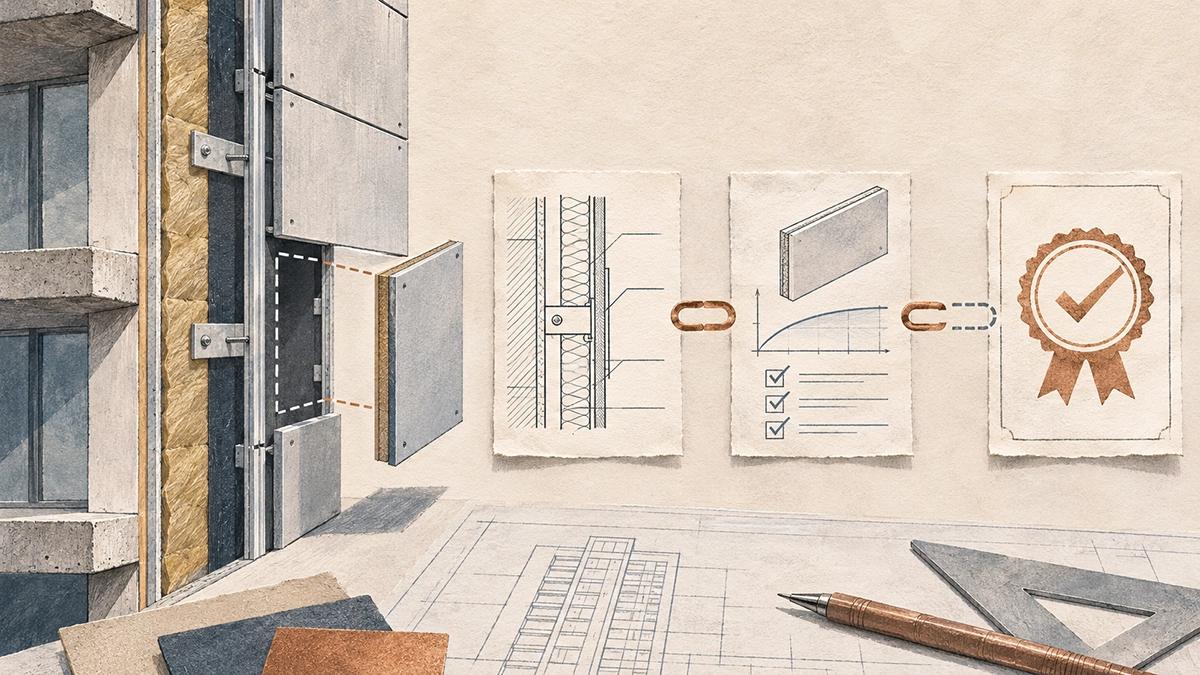
The Grenfell Inquiry specification lessons are vital for anyone who writes, reviews or approves building product requirements. The fire at Grenfell Tower on 14 June 2017 killed 72 people. The Inquiry’s final report, published in September 2024, examined a long chain of failures. No single purchasing or design decision explains the tragedy.
One finding demands particular attention from specifiers: a proposed product must be assessed for its intended use within the whole building system. A lower price, a manufacturer’s claim or a certificate cannot replace that assessment.
Grenfell Inquiry specification lessons: the cladding choice
The refurbishment architect had wanted zinc rainscreen panels. As cost became more important, the project selected aluminium composite material panels instead. The Inquiry found that the choice was made largely on cost grounds.
A product substitution may also change the design. The proposed material must be checked against the building’s requirements, the applicable rules and the performance of the complete assembly.
The Inquiry found that organisations involved in designing and constructing the external wall failed to establish and fulfil clear responsibilities for those checks. Several assumed someone else was responsible for confirming the materials’ suitability and safety.
This was part of a much wider set of failures. For a specifier, it raises a practical question: who has the competence and authority to assess a proposed substitution, and what evidence must they examine before approving it?
Why product claims and certificates need scrutiny
The Grenfell Inquiry specification lessons also extend to the evidence used to justify product choices. The Inquiry found serious problems with information about some construction products. Manufacturers made misleading claims, while weaknesses in testing and certification allowed certificates that gave an unreliable picture of product performance.
A certificate must be read for what it actually covers. Does it relate to the proposed product, configuration and intended use? What was tested? Were there limits or conditions? Does the evidence address the performance of the complete system?
These questions matter when a substitution is described as an “equivalent” product. Equivalent in appearance or price does not establish equivalent performance.
A safer process for product substitution
The Grenfell Inquiry specification lessons show why every proposed substitution needs a documented technical review. Value engineering can identify worthwhile savings, but the project team must verify that a replacement meets the required standards before approving it.
For safety-critical products, I would expect the team to:
- define the original specification’s performance and safety requirements;
- identify exactly what the proposed substitution changes;
- obtain relevant, current test and certification evidence;
- check that the evidence applies to the intended installation and complete system;
- name the qualified person responsible for technical approval; and
- record the decision, any conditions and the revised design information before installation.
Terms such as “or approved equivalent” need defined criteria and a clear approval process. They should never leave a supplier, designer or client guessing who will verify a proposed product.
The Grenfell Inquiry’s findings extend far beyond specification writing. They show why commercial savings must remain subject to competent design review, reliable evidence and clear accountability.
Our Developing Effective Specifications and Scopes of Work course on 18 February 2027 helps technical and commercial managers write clearer requirements, assess proposed changes and define approval responsibilities.
Check out our course here
