
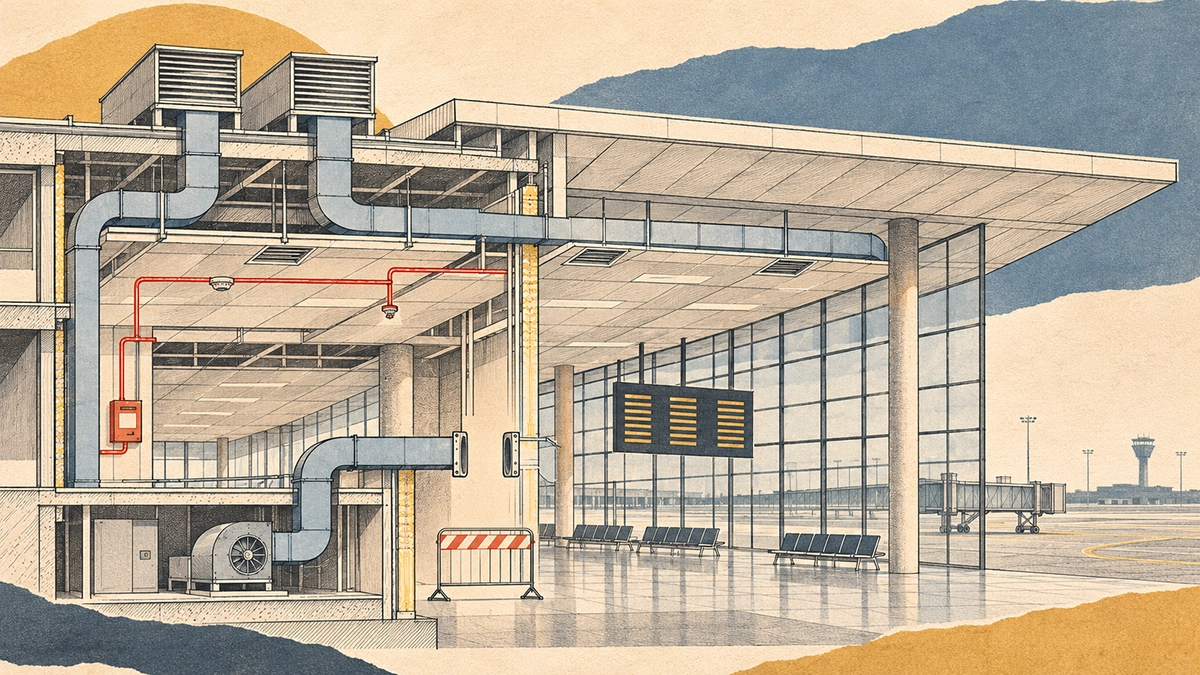
The Berlin Airport specification lessons are a reminder that a building is ready only when its essential systems work together and meet the required approvals. Berlin Brandenburg Airport was initially scheduled to open in October 2011. Its main terminal finally opened on 31 October 2020.
The delay had several causes. Problems with fire protection and smoke extraction were particularly significant. For procurement and project teams, the case raises a practical question: can the specified systems be installed, integrated, tested and accepted before the promised opening date?
Berlin Airport specification lessons: the fire protection system
The airport operator’s project timeline records that the planned June 2012 opening was cancelled because completion and building approval could not be achieved in time. A later October 2013 opening date was also cancelled because of problems with the fire protection system.
The response required more than fixing an isolated component. In 2013, the project submitted a revised concept for its smoke extraction system. This included dividing its largest smoke extraction system into three parts and installing a higher-level safety controller.
These changes show how much depends on the interfaces between building systems. Fans, controls, alarms, doors and other equipment must operate together under defined conditions. A specification that describes each item separately may still leave the project without a demonstrably working system.
Define how the complete system will be proved
The Berlin Airport specification lessons extend beyond fire protection. Complex projects often have detailed requirements for individual components but less clarity about how the complete arrangement will be tested.
Before awarding work, the customer and suppliers should agree:
- what each system must achieve;
- which contractor designs, installs and connects each part;
- how equipment from different suppliers will communicate;
- who owns and approves changes to the design;
- what integrated tests will demonstrate compliance; and
- what evidence is required for final acceptance.
These points belong in the specification and scope of work. Leaving them until commissioning can expose gaps when the project has little time left to resolve them.
Control changes and plan for commissioning
Requirements may change during a long project. Every proposed change should therefore be assessed for its effect on connected systems, approvals, testing and the opening programme.
The airport operator’s timeline records a further important step before opening: a successful fire protection and evacuation exercise in August 2020. The terminal received confirmation of completion earlier that year.
A project team should plan that route to acceptance from the beginning. It needs realistic time for installation, integrated testing, correction of faults, retesting and approval. A completion date based only on finishing visible construction does not establish operational readiness.
The wider commercial lesson is straightforward. A buildable specification must describe the required outcome and the evidence that will prove the complete system delivers it.
Our Developing Effective Specifications and Scopes of Work course on 18 February 2027 helps technical and commercial managers define requirements, responsibilities, interfaces, testing and acceptance criteria before they become costly project problems.
Check out our course here
